

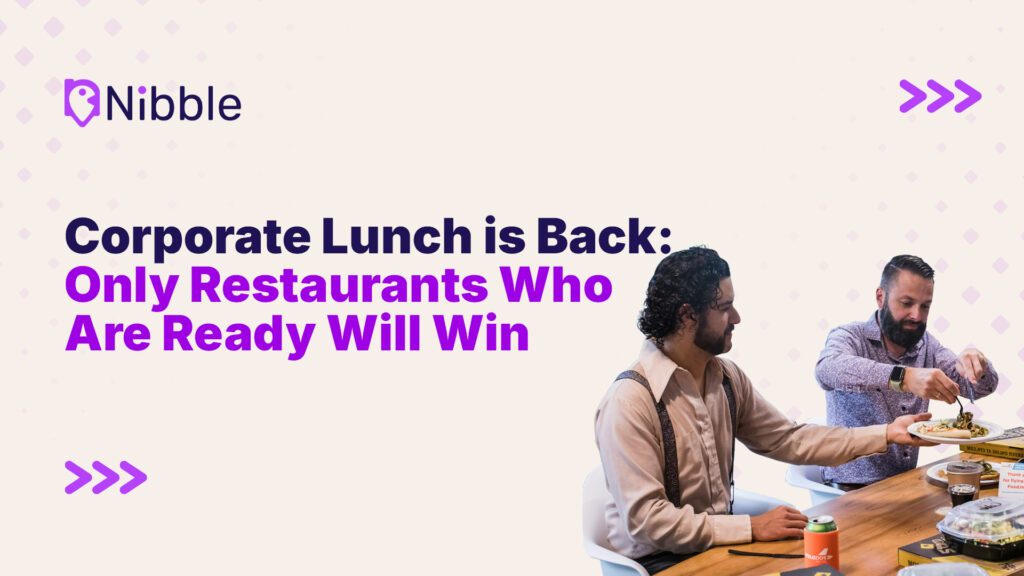
For a few years, corporate catering felt like a channel on life support. Office buildings sat empty. Lunch budgets got cut. The team lunches, client meetings, and all-hands events that used to keep restaurant catering operations humming quietly disappeared from the calendar.
That era is over.
Return-to-office momentum has been building steadily since 2023, and by 2025 it had turned into a genuine shift. Major employers across finance, law, consulting, tech, and healthcare have moved from flexible suggestions to structured in-office schedules. Hybrid has become the norm for most knowledge workers, which means three to four days a week in an office, and those days need to be fed.
The catering opportunity that’s re-emerging as a result is significant. And the restaurants best positioned to capture it are not necessarily the biggest ones or the ones with the longest track record. They are the ones who built the right infrastructure.
What changed, and what it means
The return-to-office trend has not produced a carbon copy of pre-pandemic corporate dining. The way companies feed their teams has evolved, and understanding those changes matters if you want to serve this market well.
Individual orders are out. Group catering is in.
Before the pandemic, many companies subsidized individual meal ordering through platforms like DoorDash for Work or Seamless. Post-pandemic, finance teams have largely pulled back on per-employee meal stipends. What has replaced them is group catering: one order, one delivery, one invoice. It is more cost-effective for the company and, for restaurants, means significantly larger average order values.
Food is being used as a retention and culture tool.
The logic among HR and operations leaders goes like this: if you are asking people to commute in, you need to make the office worth showing up to. Catering is part of that equation. Companies are investing in team lunches as a way to build culture, reward attendance, and reduce the friction of in-person days. That framing elevates catering from a logistics function to a strategic one, and it means the budget conversation is different than it used to be.
Hybrid schedules concentrate demand on specific days.
Most hybrid companies have anchor days, Tuesday through Thursday being the most common. This creates predictable, repeating demand that is extremely valuable for catering operations. A restaurant that captures even two or three anchor-day accounts has a reliable revenue base it can build around.
Corporate coordinators want simplicity above all else.
The person placing a catering order for a 30-person team meeting is usually not a professional event planner. They are an office manager, an executive assistant, or a department lead who has fifteen other things to do. They want a clear menu, an easy ordering process, reliable delivery, and a vendor they can trust to repeat the same order next month without incident. Complexity is a dealbreaker.
The size of what is coming back
The numbers behind this shift are not small.
The U.S. corporate catering market was valued at roughly $22 billion before the pandemic. Recovery has been uneven, but the trajectory is clear. As more companies formalize return-to-office policies and lock in recurring catering relationships for 2025 and beyond, the competitive window for restaurants is now.
The accounts being set up this year will not be re-evaluated until next year at the earliest. Corporate catering relationships are sticky. Once a coordinator finds a vendor they trust, they keep using them. The restaurant that gets on the approved vendor list for a 200-person office this quarter is likely to hold that account for years.
That stickiness is exactly what makes the current moment consequential. The restaurants establishing relationships right now are not just winning individual orders. They are locking in recurring revenue that compounds over time.
Why readiness is the differentiator
Here is what makes this moment different from a typical growth opportunity: the winners will not be determined by geography or cuisine alone. They will be determined by operational readiness.
A corporate coordinator does not choose a catering vendor because of a great Instagram account or a glowing Yelp review. They choose based on a very specific set of criteria:
Can I easily browse the menu and place an order without calling anyone? Can I schedule ahead and trust the logistics to work? Will the food arrive on time, in good condition, labeled correctly? Can I handle a recurring order without rebuilding the whole thing from scratch each time? Can I get a receipt that works for expense reporting?
These are not questions about food quality. They are questions about process. And for restaurants that have built their catering operation on phone orders, manual coordination, and improvised delivery, the honest answer to most of them is: not really.
The restaurants winning corporate accounts right now have:
A branded, self-serve ordering experience. The coordinator should be able to find your catering page, browse options, customize for dietary restrictions, schedule a delivery date, and confirm the order without human intervention on your end. If you require a phone call to start the process, you are losing accounts before the conversation begins.
Scheduling and lead time controls. Corporate clients plan ahead. They also sometimes need to move fast. Your ordering system should handle both, enforcing minimum lead times that protect your kitchen while giving customers enough flexibility to feel accommodated.
Reliable delivery with real-time visibility. Late deliveries to a 12:00 meeting that starts at 12:00 are not just inconvenient. They are trust-destroying. Integrated delivery, with automated communication to the customer about order status, is the difference between a one-time order and a recurring account.
Clean invoicing and easy reordering. Corporate clients need receipts that work for expense management. They also want to be able to repeat last month’s order in two clicks rather than rebuilding it from scratch. These are table-stakes features for anyone serious about serving this market.
A system that remembers the customer. The first order is an audition. The second order is a relationship. If your catering operation has no CRM, no order history, and no way to follow up or make the reorder frictionless, you are treating every corporate client like a stranger every time they come back.
The accounts that matter most
Not all corporate catering is equal. For restaurants building a sustainable catering channel, a few account types are worth prioritizing.
Recurring team lunches. These are the accounts that drive the most predictable revenue. A 25-person marketing team that orders every Tuesday is worth more than a 100-person event that happens once. Prioritize customers who have repeating needs, and make reordering as frictionless as possible.
Onboarding and training events. Companies with active hiring are ordering catering for new employee orientations, training sessions, and first-week lunches on a rolling basis. These accounts often start as one-time orders and become recurring ones once the coordinator has a vendor they trust.
Client-facing meetings and working lunches. These tend to be smaller orders but higher dollar-per-person, because the food reflects on the company hosting the meeting. Quality and presentation matter more here than volume pricing.
Healthcare, legal, and financial offices. These sectors never fully left the office, even during the height of remote work. They have established catering budgets, predictable schedules, and often require tax-exempt invoicing. If your ordering system handles tax-exempt documentation cleanly, you have an advantage with these accounts that most competitors do not.
The window is open now
Corporate catering relationships are being established right now. Companies that moved back to structured in-office schedules in the past 12 to 18 months are either already locked into a catering vendor or still looking for one they can trust.
The restaurants that show up with the right infrastructure: a clean ordering experience, integrated delivery, a CRM that tracks and builds the relationship, and the ability to make reordering effortless, will win those accounts. The ones that are still taking orders by phone and coordinating delivery manually will lose them to whoever makes it easier.
Corporate lunch is back. The question is not whether the demand is there. It is whether your operation is built to capture it.
Nibble ONE gives restaurants everything they need to compete for corporate catering accounts: branded online ordering, built-in CRM, delivery integrations, and easy reordering. Book a demo to see what it looks like for your operation.